Every utility-scale solar proposal we are shown for Bangladesh opens with the resource case. It is a reasonable place to start and it is almost never where the project fails. Irradiance across most of the country is adequate for commercial generation, module costs have fallen far enough to absorb a mediocre resource, and appetite for clean offtake is real and policy-supported.
What fails is land. Specifically: contiguous, unencumbered, flood-tolerant land, close enough to a connection point that evacuation does not consume the project economics. In the delta that combination is scarce, and assembling it is a facilitation problem long before it is an engineering one.
What land means in the delta
Bangladesh is one of the most densely populated countries on earth and the great majority of usable land is either cultivated, settled or seasonally inundated. A utility-scale array needs a footprint measured in hundreds of acres. Very little land of that size sits in a single ownership, and almost none of it sits idle.
Title itself is the first complication. Holdings fragment across generations through inheritance, so a single field may have many beneficial owners, some of whom are abroad and some of whom are not recorded. Records are maintained in more than one register, and the mutation of a record frequently lags the transaction it reflects. A seller can be entirely honest and still not be able to convey what a lender will accept as security.
The second complication is what the land is doing now. Acquiring productive agricultural land carries a social cost and a political visibility that developers consistently underestimate. Community objection does not usually stop a project outright; it slows it, conditions it, and reappears at every subsequent approval.
The third is water. Elevation, drainage and seasonal inundation determine foundation design, access road specification and insurability. Land that is available is often available precisely because it floods.
Grid adjacency narrows the map again
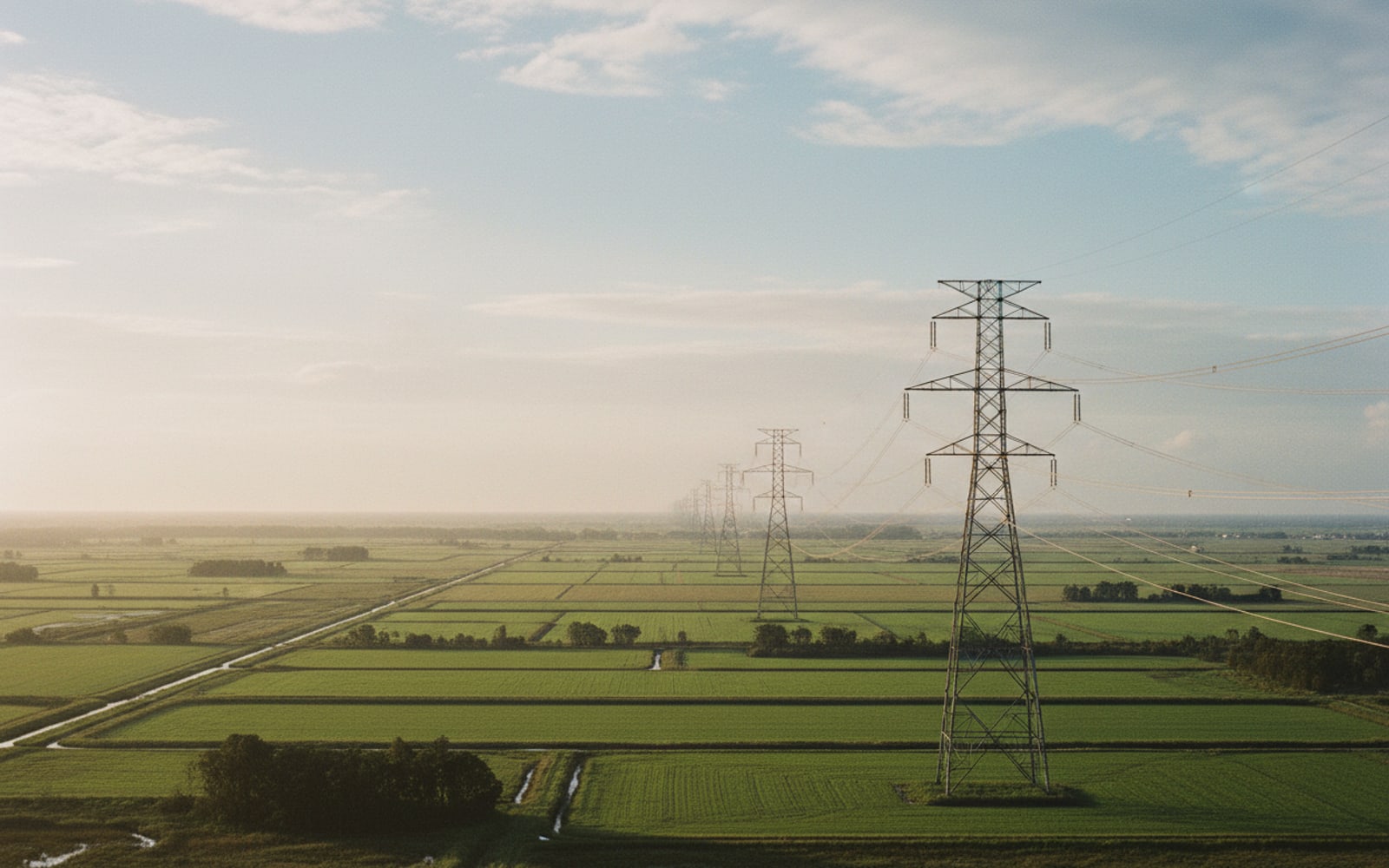
Solve for land alone and you will find sites. Solve for land and connection together and the map contracts sharply. Generation is only worth what the network can move, and transmission and distribution capacity has not expanded at the pace of installed generation. A site that requires a long dedicated line, a new substation bay or reinforcement of an existing corridor carries a cost and a programme risk that sits outside the developer’s control.
The consequence is that connection feasibility belongs at the front of site selection rather than at the end of it. The question is not whether a connection can be consented, but whether the entity responsible for building it has the capacity, the budget line and the sequencing to do so inside the project timetable.
Aggregation is a process, not a purchase
Assembling a site from many small holdings is a sustained programme of work with its own staffing, its own timetable and its own failure modes. Done properly it involves independent title verification parcel by parcel; a single acquisition entity so that the boundary does not fragment across vehicles; an option structure that holds parcels without committing full consideration before the project is bankable; and a deliberate approach to the last holdout, who will be identified early by everyone in the district and will price accordingly.
Where a public body is the acquiring party, the statutory route and its compensation schedule apply, and the process is more predictable but not faster. Where the developer aggregates privately, speed is available but so is the ratchet: each parcel acquired increases the leverage of the parcels that remain.
The single most common error is running aggregation quietly in the belief that discretion keeps prices down. It does, briefly. It also means the community learns about the project from rumour rather than from the developer, which is a poor foundation for a thirty-year asset.
Structuring around the constraint
Because land is the binding constraint, the structures that work are the ones that reduce exposure to it. Rooftop and industrial-captive generation avoids aggregation entirely and monetises a tariff that is already high, at the cost of scale per project. Floating installations on water bodies avoid competition with agriculture and carry their own technical and consenting questions. Zone-based development transfers the land question to an authority that has already resolved it, in exchange for accepting that authority’s framework. Repowering and expansion at existing sites buys land and connection in one instrument.
Each of those has a different risk profile and none is universally correct. What they share is that they treat land as the primary variable rather than as a line item to be settled after the tariff is agreed.
Bangladesh will build a great deal of solar capacity over the next decade. The developers who capture it will not be the ones with the cheapest modules. They will be the ones who understood, before committing capital, that they were entering a land market that happens to produce electricity.