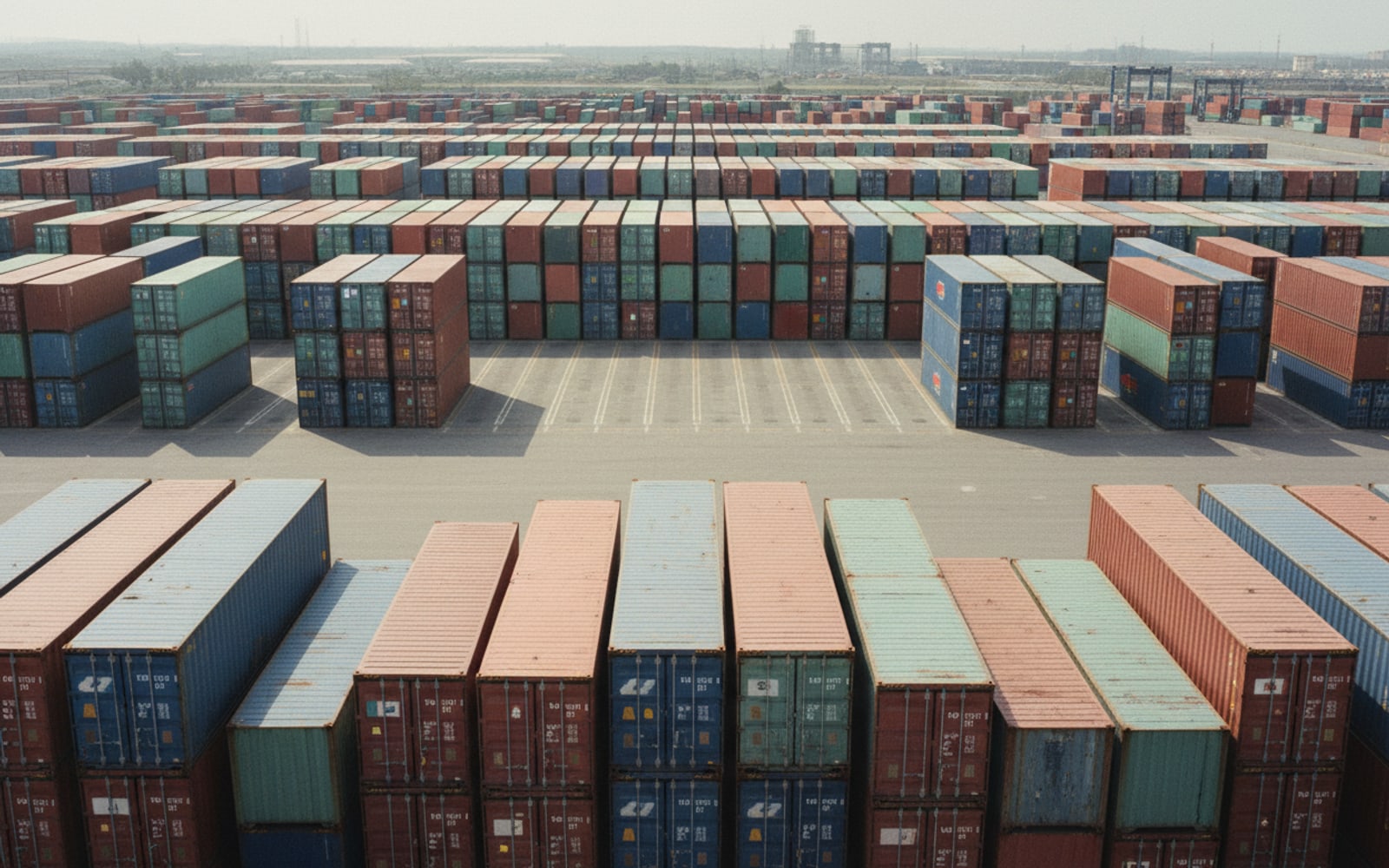
Container throughput in Bangladesh has grown for most of a decade at a rate that quay capacity has not matched. That gap is well known inside the industry and consistently misread outside it, because the consequences do not appear in port statistics. They appear in inland logistics costs, in inventory policy, in the working capital that exporters carry, and ultimately in the delivered cost of Bangladeshi goods at a European or North American shelf.
The concentration problem
The structural issue is not the absence of ports. It is that the great bulk of container trade moves through one river-mouth complex, and that complex is physically constrained in ways that no amount of operational improvement can remove. Channel depth and vessel length limits determine which ships can call. Those limits, in turn, determine that most Bangladeshi cargo cannot travel on a mainline vessel from origin to destination and must be transhipped through a hub elsewhere in the region.
Transhipment is not a marginal inconvenience. It adds a handling event, it adds days, and — more importantly — it puts the reliability of Bangladeshi supply chains partly in the hands of terminals in other countries. When a regional hub congests, Bangladeshi exporters absorb the delay without any ability to influence it.
A single dominant gateway also concentrates risk. Weather closure, industrial action, channel siltation or a customs systems outage at one location propagates through the entire external trade account within days. Diversification of gateway capacity is a resilience argument before it is a throughput argument.
Where the cost actually lands
Port congestion is usually described in terms of vessel waiting time and container dwell. Those are the visible measures and they understate the problem. The larger cost sits inland.
When yard capacity is tight, boxes are moved to inland depots and moved again, and each additional handling is a charge and a damage risk. When dwell is unpredictable, exporters hold buffer stock, which is working capital that does not earn. When road haulage to and from a single gateway is the only reliable mode, congestion on that corridor prices every consignment that uses it. When lead times are variable, buyers respond with tighter terms or with dual sourcing, which is the most expensive outcome of all and never shows up as a logistics cost at all.
A second driver of dwell is documentary rather than physical. Where clearance depends on paper moving between agencies, on physical inspection rates that are high by regional standards, or on systems that do not talk to each other, boxes sit in a yard that is already short of space for reasons that have nothing to do with quay length. Investment in the customs interface frequently buys more effective capacity per unit of spend than investment in handling equipment, and it is available on a far shorter timetable.
This is why throughput figures alone are a poor guide to whether the system is working. A port can report record volumes while the economy it serves is paying steadily more to move each box.
Matarbari and Payra are not the same answer
Two deep-water propositions dominate the discussion, and they solve different problems.
The Matarbari development is the one that changes the vessel-size equation. Deep-water capability there would allow larger ships to call directly, which is the only intervention that addresses the transhipment dependency at its root. It is also a very large, long-dated, sovereign-supported programme, and its value to a private investor depends less on the quay itself than on the industrial and logistics positions that a deep-water gateway makes viable around it.
Payra is a different case. Its constraint is maintenance dredging: the sediment load in this delta is enormous, and a port whose viability depends on continuous dredging carries an operating cost profile that has to be underwritten honestly rather than optimistically. That does not make it a poor asset. It makes it an asset whose economics are dominated by a recurring cost rather than by a capital cost.
Meanwhile the incremental capacity programmes at the existing complex — additional terminal capacity and improved handling — will carry the volume in the interim, and are where the nearest-term operating concessions sit.
The inland half of the problem
Quay capacity without inland capacity relocates the queue. Every serious assessment of Bangladeshi port economics ends in the same place: the constraint migrates to the road corridor, the inland container depot network, the customs interface and, increasingly, the absence of rail-served terminal capacity.
Inland waterways are underused relative to their potential and are the cheapest mode available in a delta. Rail connectivity to terminals changes the cost per box materially where it exists. Cold chain capacity determines whether agricultural exports can address anything beyond the regional market. These are unglamorous assets and they are where a private investor can take a position without competing with a sovereign programme.
What this implies for investors
First, that gateway diversification is a policy direction rather than a speculation, and positions taken around it are positions taken with the grain of the state rather than against it.
Second, that the returns are more accessible in the connecting infrastructure than in the headline port. Depots, handling equipment, haulage fleets, bonded warehousing, rail links and cold chain are smaller, faster to build, and considerably less exposed to the political economy of a national programme.
Third, that any position in this sector should be underwritten against landed cost per container rather than against throughput growth. Throughput will grow. Whether it grows profitably for a given asset depends on where in the chain the queue forms next.